
The Jurisprudence of "Insanity" in Criminal Law: Deconstructing Legal Insanity vs. Medical Insanity
DOI:
https://doi.org/10.5281/zenodo.23256878Palavras-chave:
Diminished Responsibility, Mental Healthcare Act 2017, M'Naghten Rules, Section 22 Bharatiya Nyaya Sanhita, Medical Insanity, Legal InsanityResumo
The defence of insanity occupies a singular position within the General Exceptions to criminal liability, resting on the premise that the criminal law punishes only those who possessed, at the material time, the capacity to form a guilty mind. This article undertakes a doctrinal examination of the insanity defence under Indian criminal law, tracing its conceptual genesis to the M'Naghten Rules of 1843 and its statutory expression, first as Section 84 of the Indian Penal Code, 1860, and now as Section 22 of the Bharatiya Nyaya Sanhita, 2023 (BNS). The central problem addressed is the persistent conflation, in lay and sometimes in forensic discourse, of "medical insanity" a clinical diagnosis of mental illness with "legal insanity", a narrower construct confined to the accused's incapacity, at the time of the act, to know its nature or that it was wrong or contrary to law. Through an analysis of State of Madhya Pradesh v Ahmadulla, Dahyabhai Chhaganbhai Thakkar v State of Gujarat, Jai Lal v Delhi Administration, Hari Singh Gond v State of Madhya Pradesh, Surendra Mishra v State of Jharkhand, Devidas Loka Rathod v State of Maharashtra, Prakash Nayi Sen v State of Goa and Dashrath Patra v State of Chhattisgarh, the article shows how the Supreme Court has policed this boundary while progressively easing the evidentiary burden on the accused. That burden is discharged on a preponderance of probabilities under Section 105 of the Indian Evidence Act, 1872 (now Section 108 of the Bharatiya Sakshya Adhiniyam, 2023), leaving the prosecution's overarching burden of proving guilt beyond reasonable doubt undisturbed. Accused 'X' v State of Maharashtra is examined separately, as an authority on post-conviction mental illness rather than on the insanity defence itself. The analysis situates the doctrine within the rights-based framework of the Mental Healthcare Act, 2017 in particular Section 3(5), which separates a clinical determination of mental illness from a judicial finding of unsoundness of mind and the procedural provisions of Chapter XXVII (Sections 367–378) of the Bharatiya Nagarik Suraksha Sanhita, 2023. Using doctrinal legal research, the article argues that Section 22 of the BNS preserves doctrinal continuity but inadequately integrates contemporary mental health law. It concludes by proposing calibrated reforms consideration of a partial defence of diminished responsibility, standardised forensic psychiatric evaluation, and closer coordination between criminal courts and Mental Health Review Boards while addressing the principal objections to each.
Downloads
Referências
Accused 'X' v State of Maharashtra (2019) 7 SCC 1.
Bachan Singh v State of Punjab (1980) 2 SCC 684.
Bapu Gajraj Singh v State of Rajasthan (2007) 8 SCC 66.
Bharatiya Nagarik Suraksha Sanhita 2023 (India).
Bharatiya Nyaya Sanhita 2023 (India).
Bharatiya Sakshya Adhiniyam 2023 (India).
Code of Criminal Procedure 1973 (India).
Coroners and Justice Act 2009 (UK).
Dahyabhai Chhaganbhai Thakkar v State of Gujarat AIR 1964 SC 1563, (1964) 7 SCR 361.
Dashrath Patra v State of Chhattisgarh 2025 LiveLaw (SC) 618 (Criminal Appeal No 821 of 2025, decided 8 May 2025).
Devidas Loka Rathod v State of Maharashtra (2018) 7 SCC 718.
Duffy, R. M. and B. D. Kelly. 2020. India's Mental Healthcare Act, 2017: Building Laws, Protecting Rights. Singapore: Springer.
Hari Singh Gond v State of Madhya Pradesh (2008) 16 SCC 109.
Homicide Act 1957 (UK).
Indian Evidence Act 1872 (India).
Indian Law Commissioners. 1837. A Penal Code Prepared by the Indian Law Commissioners.
Indian Penal Code 1860 (India).
Jai Lal v Delhi Administration AIR 1969 SC 15.
Law Commission (England and Wales). 2013. Criminal Liability: Insanity and Automatism – A Discussion Paper. London: Law Commission.
Mental Healthcare Act 2017 (India).
M'Naghten's Case (1843) 10 Cl & F 200, 8 ER 718.
Modi, J. P. 2018. A Textbook on Medical Jurisprudence and Toxicology. 26th edn. LexisNexis.
Prakash Nayi Sen v State of Goa (2023) 5 SCC 673.
R v Golds [2016] UKSC 61.
Ratan Lal v State of Madhya Pradesh (1970) 3 SCC 533.
Royal Commission on Capital Punishment 1949–1953. 1953. Report. Cmd 8932. London: HMSO.
Rupesh Manger (Thapa) v State of Sikkim 2023 INSC 826.
Shatrughan Chauhan v Union of India (2014) 3 SCC 1.
State of Madhya Pradesh v Ahmadulla AIR 1961 SC 998.
Surendra Mishra v State of Jharkhand (2011) 11 SCC 495.
Vijayee Singh v State of Uttar Pradesh (1990) 3 SCC 190.
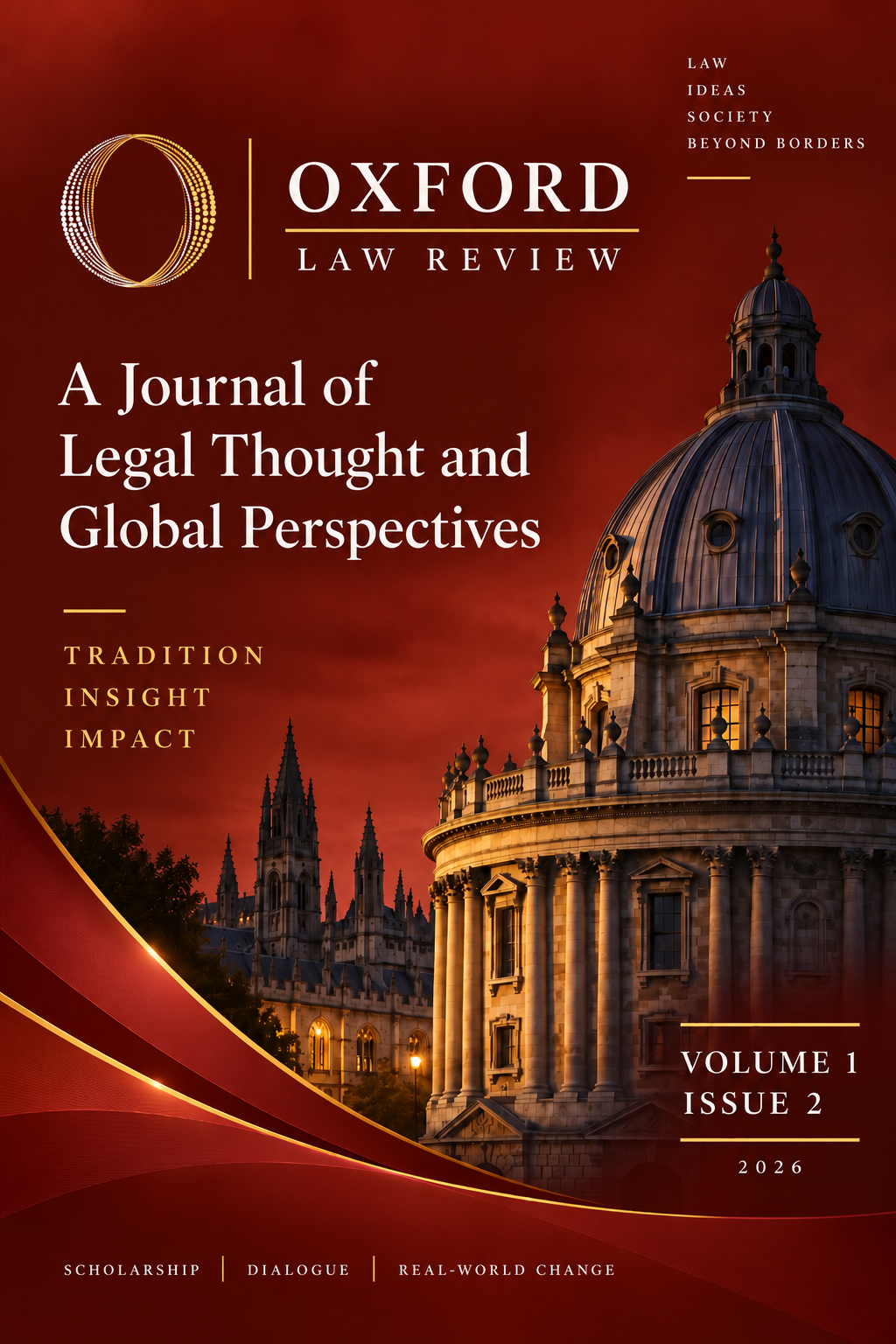
Downloads
Publicado
Declaração de Disponibilidade de Dados Científicos
Not applicable. This article is based on doctrinal legal research using publicly available statutes, judicial decisions and secondary literature; no new datasets were generated or analysed.
Edição
Secção
URN
Licença
Direitos de Autor (c) 2026 Oxford Law Review

Este trabalho encontra-se publicado com a Licença Internacional Creative Commons Atribuição 4.0.
Content published by Oxford Law Review is made available subject to the copyright and licensing terms applicable to the individual article.
Unless otherwise stated on the article page, the following terms apply:
1. Copyright
Copyright in published articles remains subject to the rights and terms specified for the respective publication. Authors and users should respect all applicable copyright and intellectual property laws.
2. Use of Published Material
Published articles may be accessed, read, cited and referenced for legitimate scholarly, educational and research purposes, subject to applicable copyright and licensing restrictions.
3. Reproduction
Reproduction, redistribution, adaptation or commercial use of published material is permitted only where expressly authorised by the applicable licence or by the relevant copyright holder.
4. Citation and Attribution
Any permitted use of material published by Oxford Law Review must provide appropriate bibliographic attribution, including the author, article title, Journal name and publication details, and a persistent link to the original article where available.
5. Third-Party Material
Material belonging to third parties, including photographs, illustrations, tables, datasets or other copyrighted content, may be subject to separate copyright or licensing conditions. Users are responsible for obtaining any permission required for such use.
6. Author Rights
Authors retain such rights as are provided under the applicable publication and licensing agreement. The specific rights applicable to each article are indicated with the published work where appropriate.
7. Changes to Licensing Terms
Oxford Law Review may update its licensing terms from time to time. The terms applicable to a published article will be those stated with or otherwise governing that article.
For the licensing status of a particular article, please refer to the licence information displayed on its publication page.
Como Citar