O czasopiśmie
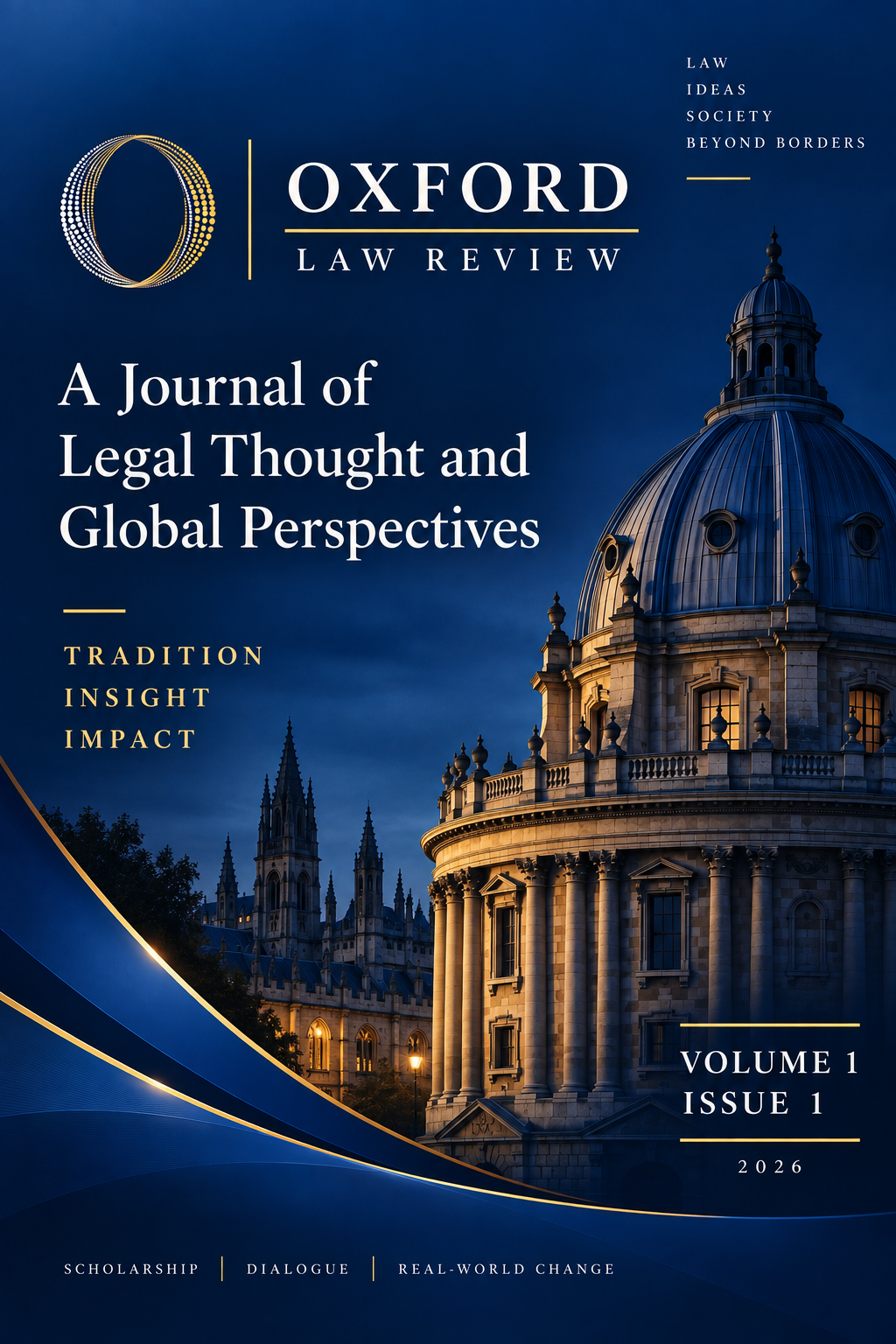
Oxford Law Review is an independent, international, double-blind peer-reviewed academic journal dedicated to the publication of original and rigorous scholarship in law and related fields of the humanities and social sciences. The Journal provides a forum for sustained academic engagement with legal doctrine, theory, history, institutions, society, and the wider intellectual contexts in which law develops and operates.
The Journal publishes three issues each calendar year and welcomes original research from scholars, researchers, academics, practitioners, and other contributors whose work makes a substantive contribution to legal scholarship.
Scope of the Journal
The Oxford Law Review adopts a broad and interdisciplinary conception of legal scholarship. It welcomes research across the full spectrum of public and private law, including:
- Constitutional and Administrative Law
- Criminal Law and Criminal Justice
- Civil and Private Law
- Commercial and Corporate Law
- International and Comparative Law
- Human Rights and Humanitarian Law
- Environmental and Climate Law
- Technology, Artificial Intelligence and Digital Law
- Jurisprudence and Legal Philosophy
- Legal History
- Socio-Legal Studies
- Public Policy and Regulation
- International Relations and Transnational Law
- Emerging areas of legal scholarship
The Journal also welcomes interdisciplinary scholarship examining the relationship between law and other fields. Relevant contributions may include Law and Economics, Law and Politics, Law and Psychology, Law and History, Law and Sociology, Law and Philosophy, Law and Culture, Law and Anthropology, Law and Criminology, Law and International Relations, Law and Public Policy, and related areas.
An article therefore need not fall exclusively within a conventional legal category to be considered. Interdisciplinary submissions are particularly welcome where the engagement with another discipline materially advances the analysis of a legal question or contributes to understanding law, legal institutions, or legal processes.
International Editorial Community
The Journal maintains an international and interdisciplinary editorial structure comprising scholars working across different jurisdictions, legal traditions, and academic disciplines. Its wider academic network includes specialists in public and private law, international law, comparative law, legal history, jurisprudence, human rights, criminal justice, law and society, political science, economics, philosophy, anthropology, and related fields.
The Journal's academic network is complemented by an independent peer-review community. Reviewers are approached according to the subject matter and specialist requirements of individual manuscripts.
Independent Double-Blind Peer Review
Manuscripts are subject to an independent double-blind peer-review process. Where a submission proceeds to external review, identifying information concerning the author is removed from the manuscript provided to reviewers, and reviewer identities are not disclosed to authors.
Reviewers are contacted independently according to the relevance of their expertise to a particular manuscript. Consequently, not every Editorial Board member or peer reviewer reviews every submission. A particular scholar may be approached where an article corresponds closely to their field, jurisdiction, methodology, historical period, or interdisciplinary expertise.
The Journal may also refrain from approaching an individual because of academic or professional commitments, availability, expertise, or a potential conflict of interest. The identities of reviewers assigned to particular manuscripts remain confidential.
Editorial Independence
Oxford Law Review is an independent academic journal. It is not owned, operated, governed, controlled, sponsored, or academically administered by the University of Oxford or by any other university.
The name of the Journal does not indicate or imply an institutional affiliation, endorsement, sponsorship, or academic relationship with the University of Oxford.
Editorial decisions are made through the Journal's established editorial procedures and are based on scholarly considerations, including originality, academic quality, relevance, methodological soundness, and contribution to the field. No university, governmental body, commercial organisation, sponsor, donor, or other external institution controls the Journal's academic editorial decisions.
Read the Editorial Independence Statement →
For Authors
The Journal welcomes original scholarly articles that offer a substantive contribution to legal research. Submissions are considered on the basis of their academic quality, originality, relevance, clarity of argument, methodological rigour, and contribution to existing scholarship.
There is no fee for submitting a manuscript. Where an article is formally accepted for publication, an applicable Article Processing Charge may be payable in accordance with the Journal's published APC policy. Editorial decisions are independent of any applicable publication charge, and no APC is payable for articles that are rejected.
Authors should consult the Journal's requirements concerning manuscript preparation, originality, citations, declarations, ethics, and submission before submitting their work.
Author Guidelines →
Submission Guidelines →
Article Processing Charges →
Publication Ethics and Academic Integrity
The Oxford Law Review is committed to maintaining academic integrity throughout the submission, review, editing, and publication process. The Journal expects authors to submit original work and to acknowledge sources appropriately. Manuscripts must not be simultaneously submitted for consideration by another journal where this would conflict with the Journal's submission requirements.
The Journal addresses matters including plagiarism, duplicate publication, fabrication and falsification of research, authorship disputes, conflicts of interest, inappropriate citation practices, and other forms of academic misconduct in accordance with its publication policies.
Publication Frequency
The Oxford Law Review publishes three issues annually, providing a continuing platform for the publication and dissemination of contemporary legal scholarship.
Published articles may encompass doctrinal, theoretical, comparative, historical, empirical, socio-legal, and interdisciplinary research, provided that the work makes a meaningful contribution to the Journal's field of scholarship.
Current Issue →
Journal Archive →
Open and Accessible Scholarship
The Journal seeks to facilitate the broad dissemination and accessibility of published scholarship through its online publication platform. Articles are presented in a form intended to support academic reading, citation, research, and reference.
Copyright and licensing arrangements applicable to individual articles are stated in accordance with the Journal's publication and licensing terms.
Copyright & License Terms →
Accessibility →
DOI and Scholarly Metadata
Where article-level DOI registration and associated metadata services have been formally established, the Journal assigns persistent identifiers to published articles and maintains corresponding bibliographic information to facilitate citation, discovery, and scholarly referencing.
The Journal will identify applicable scholarly infrastructure and indexing relationships on its website as those services are formally established.
Research Prize
The Oxford Law Review may annually recognise an outstanding contribution published in the Journal through its Research Prize, carrying an award of USD 500. The prize is intended to recognise exceptional scholarly contribution, originality, and research significance among eligible articles published during the relevant period.
Further details concerning eligibility and selection are provided through the Journal's prize policy.
A Global Forum for Legal Scholarship
The Oxford Law Review seeks to bring together legal scholarship across jurisdictions and disciplines while preserving editorial independence and rigorous academic assessment. Its purpose is to provide a sustained scholarly forum in which law can be examined as doctrine, institution, history, theory, and social practice.
The Journal welcomes scholarship that crosses conventional disciplinary boundaries while maintaining a clear and substantive engagement with legal questions.
Law · Ideas · Society · Beyond Borders
Explore the Journal
About the Journal · Focus & Scope · Editorial Board · For Authors · Author Guidelines · Peer Review · Publication Ethics · Article Processing Charges · Current Issue · Archive · Contact
Aktualny numer